
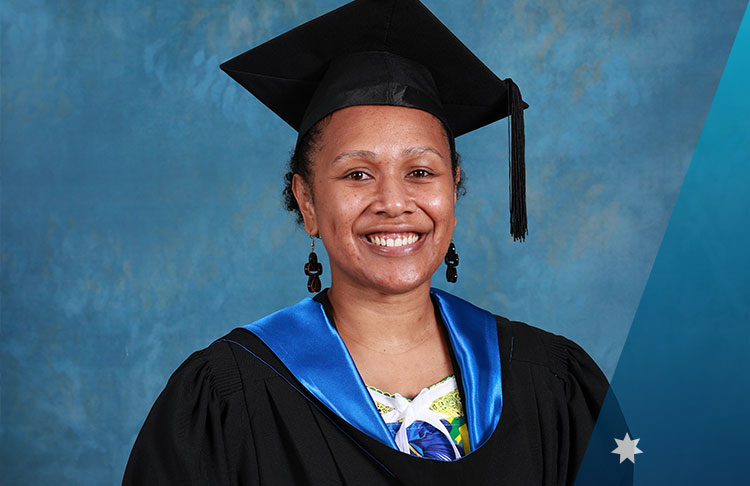
For Australia Awards alumna Trisha Toangwera Aruhuri, the pursuit of higher education was meant to be a chapter of growth, research, and professional development. But in 2023, while undertaking her Master of Applied Anthropology and Development in Australia, her life took an unexpected turn: she was diagnosed with stage 3 breast cancer.
What could have been a devastating setback became, in Trisha’s words, both an ironic twist of fate and a profound journey of learning. Only two years earlier, she had considered researching the experiences of women with breast cancer in Vanuatu. Suddenly, she found herself not just studying the issue, but living it.
For many in Vanuatu, a breast cancer diagnosis is often viewed as a death sentence, surrounded by fear and stigma. Having once witnessed that environment firsthand, Trisha was determined not to let the illness define her. “I am still me,” she recalls thinking. “That diagnosis doesn’t change who I am.”
Despite initial fears of losing her scholarship and her place in academia, Trisha found strength in advocating for herself. Driven by a deep sense of purpose—not only to succeed for her own future but also for the women whose hopes she carried—she refused to let her circumstances define her limits. With support from the university’s Student Safety and Wellbeing team, she accessed disability services and adopted new learning strategies that enabled her to continue her studies, even amid the cognitive challenges of chemotherapy-induced “brain fog.”
Throughout her treatment, faith played a central role. Trisha describes moments of prayer and fasting that gave her reassurance in the face of overwhelming medical bills and uncertainties in her treatment and recovery journey. To Trisha, the rapid financial and medical support she received—from discounted treatments to donations through a GoFundMe campaign—were nothing short of miracles.
She also found community in unexpected places: her student hall chaplain, church members in Canberra, and classmates who offered practical support. While she sometimes felt the loneliness of being away from her family in Vanuatu, the Australian healthcare system provided swift, empathetic care that became another form of family for her.
One of the most powerful lessons from Trisha’s journey is the importance of awareness and early detection. Having learned self-check techniques in high school, she was able to question a seemingly minor symptom that ultimately led to her diagnosis. She now encourages students and young professionals alike to know their bodies, seek second opinions, and speak out—even when stigma makes it difficult.
“Many women in Vanuatu hide their illness,” she reflects. “But if we don’t talk about it, we might not get the help we need. It takes a lot of courage to break the stigma of silence and seek help.”
Today, Trisha works with Save the Children as the MEAL Manager, balancing her career with ongoing medical check-ups and recovery. Her outlook on life and work has been reshaped by her experience: she approaches challenges with faith, gratitude, and a deep awareness of the need for supportive systems.
As Breast Cancer Awareness Month reminds the world of the importance of awareness, detection, and solidarity, Trisha’s story is a testament to resilience. It is also a call to action: to create environments—academic, professional, and cultural—where those diagnosed with cancer are supported rather than stigmatised.
For Trisha, survival is not just about overcoming illness; it is about embracing life with courage, faith, and the conviction that sharing her story can help others find hope.