
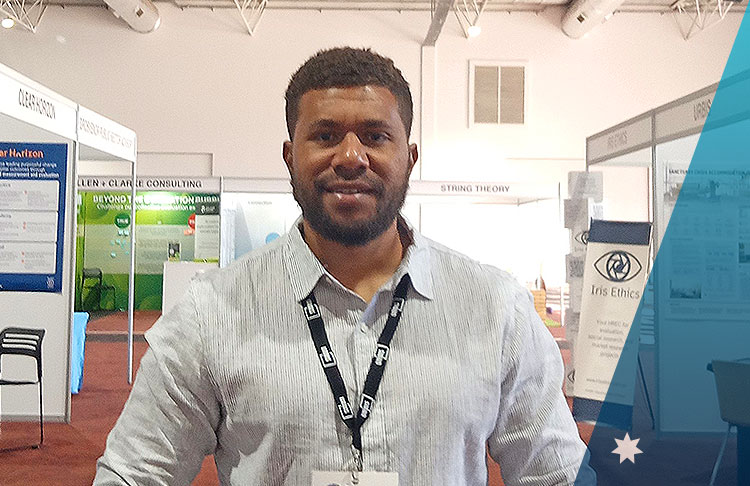
Australia Awards Vanuatu alumnus Michael Taiki recently represented Vanuatu at the Australian Evaluation Society (AES) International Conference 2025, held at the National Convention Centre in Canberra. Supported through the Australia Awards Conference Funding program, Michael joined evaluators, researchers, policymakers, and community leaders from across Australasia and the Pacific in a dialogue centred on the evolving role of evaluation in society.
Michael completed a Master of Environmental Management at Charles Darwin University through the Australia Awards, equipping him with the expertise to address the environmental and development challenges faced by Vanuatu and the Pacific. Over the past four years, he has led monitoring and evaluation (M&E) efforts for environmental and community development initiatives with regional organisations and NGOs. Today, he works full-time as an environmental scientist and M&E specialist at LOKOL SOLUTIONS, the organisation he founded in 2024. Through this platform, he supports government agencies and private sector partners in measuring and communicating program impacts, translating technical data into accessible information for decision-makers and communities. He also established the Future Leaders Mentoring Programme, where he mentors recent Ni-Vanuatu graduates through practical fieldwork and community service.
The AES25 conference theme, “Beyond the Bubble,” challenged delegates to think critically about conventional approaches and embrace inclusive and transformative practices. Discussions emphasised cultural safety, Indigenous leadership, and ethical methodologies to ensure evaluation genuinely serves communities. For Michael, the lessons from this gathering were especially relevant to Vanuatu’s development context.
Key sessions highlighted Indigenous-led evaluation, with powerful contributions from First Nations leaders, including the Mayo Kuwayu Study and the Yarrabah Leader’s Forum Seven Pillar Model. Other themes explored included the use of Artificial Intelligence in evaluation, responses to climate change, participatory approaches, and storytelling methods such as the Most Significant Change technique. These approaches resonated strongly with Michael’s belief that evaluation must go beyond numbers and reports to reflect lived experiences and community priorities.
Reflecting on his participation, Michael emphasised the importance of embedding kastom values, local knowledge, and community voices into evaluation practice in Vanuatu. He noted that inclusive evaluation—particularly the intentional involvement of women, youth, and marginalised groups—aligns with the nation’s broader goals of equity and resilience. Exposure to alternative methodologies and community-driven data models offered him practical tools for strengthening the relevance and impact of M&E systems in the Pacific.
The conference also provided valuable opportunities for professional networking and capacity building. Sessions on mentoring and supporting emerging evaluators inspired Michael to consider how he could contribute to cultivating the next generation of Ni-Vanuatu M&E professionals. With pressing challenges such as climate change and social resilience at the forefront, he sees a clear role for evaluation in shaping effective and sustainable responses.
Reflecting on his experience, Michael expressed deep appreciation for the opportunity:
“Attending the AES Conference really opened my eyes. I learned about new ideas like AI in evaluation, climate-focused frameworks, and systems thinking. Most importantly, I realised that in Vanuatu, we need Pacific-designed evaluation tools that work for us. M&E is not just about reports and numbers—it’s about making sure projects truly help our people.”
Through his participation, Michael has not only gained fresh insights and professional growth but has also strengthened his resolve to champion evaluation as a tool for equity, cultural respect, and sustainable impact in Vanuatu.