
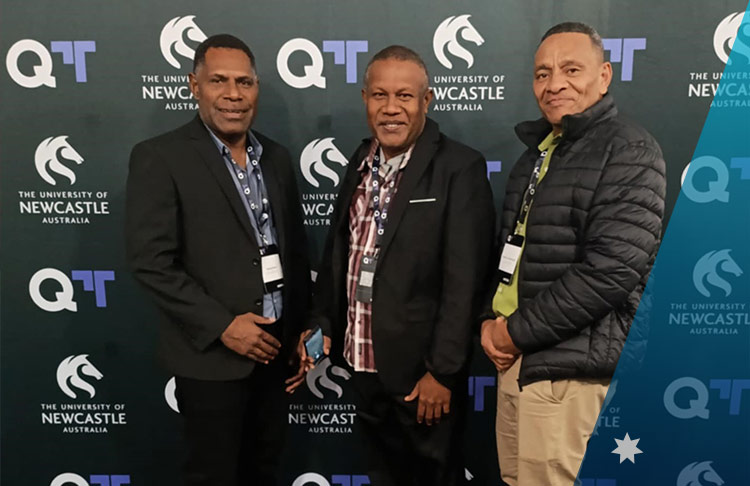
Two distinguished Vanuatu education professionals and Australia Awards Vanuatu alumni—Moses Iakavai Nasse Nambas and Lensley Livu Bani Kwiri —represented Vanuatu’s education sector at the Quality Teaching in Practice 2025 (QTIP2025) Conference, held from 8–9 July at the University of Newcastle, Australia.
As recipients of the 2024 Australia Awards Vanuatu Alumni of the Year, both alumni were given the opportunity to join educational leaders from across the Pacific and Australia to exchange ideas, strengthen professional networks, and explore innovative solutions to shared educational challenges.
The conference was structured around core themes such as inclusive education, teacher wellbeing, culturally responsive pedagogy, educational leadership, and technology in the classroom. Sessions and workshops provided space for critical reflection, policy exchange, and forward-thinking approaches to classroom practices and teacher preparation.
Moses emphasised the growing role of artificial intelligence (AI) in education, particularly tools like ChatGPT, not as replacements for teachers, but as technologies that require active teacher leadership to guide implementation. A standout session led by STEM education innovator Steve Grant underlined the importance of equipping educators with the skills to manage educational change and use data-driven strategies to improve learning outcomes. Moses noted that the conference reinforced his capacity in educational leadership, change management, and digital integration—skills vital to his supervisory role at MOET.
Lensley’s key takeaways were focused on the integration of Indigenous knowledge and vernacular languages into mainstream education. Drawing inspiration from presentations like Dr Patricia Rodie’s work on culturally inclusive pedagogy in the Solomon Islands and Professor Penny Jane Burke’s keynote on equity and justice in education, Lensley highlighted the alignment of these topics with Vanuatu’s goal to preserve cultural identity through education. Additionally, his interest in formative assessment practices, digital tools for remote classrooms, and mentorship models will shape future curriculum design and teacher support structures at the National University of Vanuatu where he currently works.
Both alumni found the conference’s networking opportunities immensely valuable, opening doors for future collaboration on Pacific-focused research and professional development initiatives. Their participation not only advanced their own professional development but also reinforced Vanuatu’s commitment to regional collaboration and educational excellence.
The QTIP2025 Conference was more than an academic event—it was a platform for transformative learning, cultural affirmation, and visionary leadership in Pacific education. Through their engagement, Moses and Lensley demonstrated how Vanuatu’s educators are actively shaping the future of teaching and learning, both at home and across the region.